
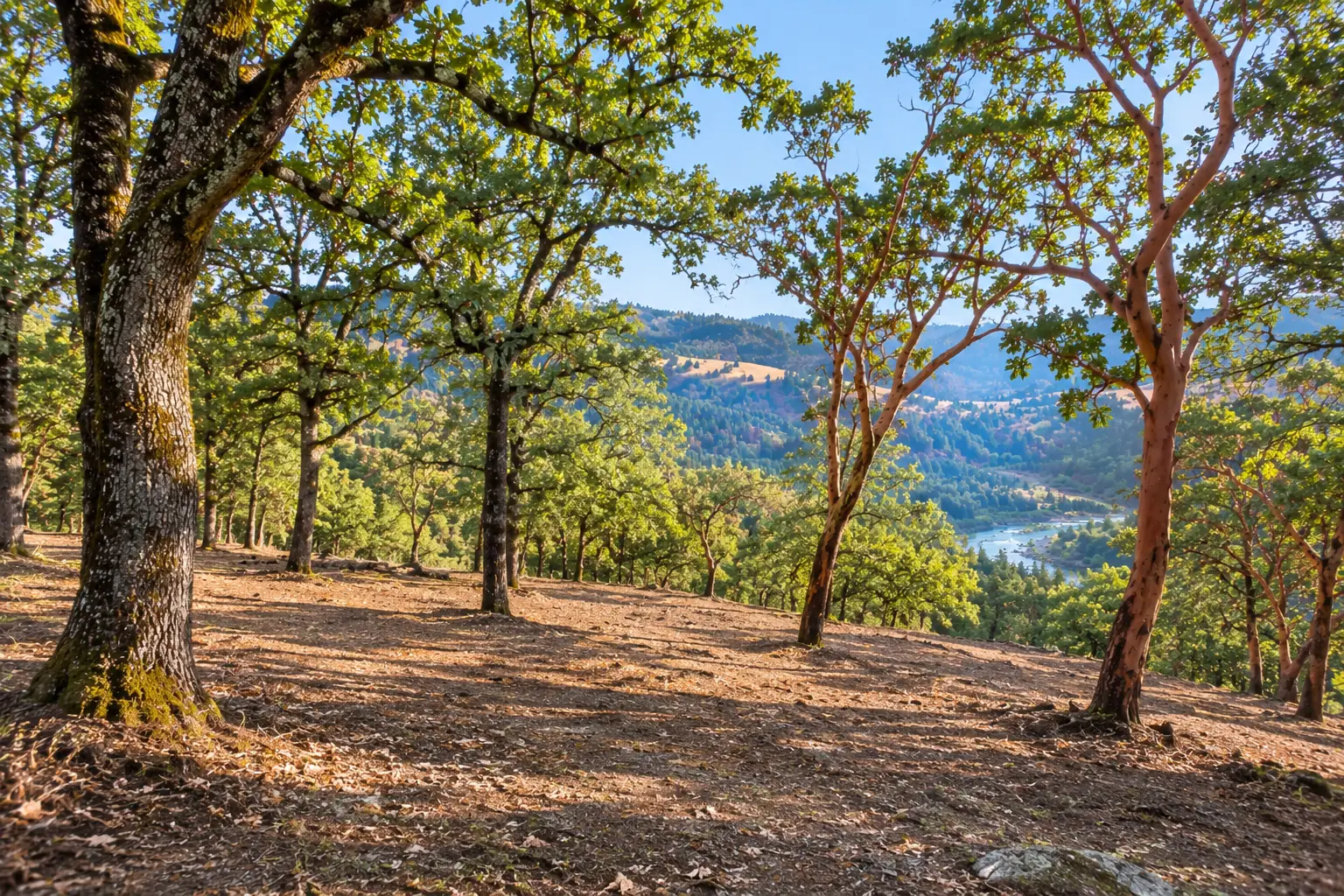
Lot clearing in Gold Hill removes brush, small trees, chosen large trees and sometimes stumps from a piece of land so it can be built on, made fire safe, fenced or opened up for pasture. Call (541) 502-8114 to be connected with an independent tree service that holds an Oregon CCB license. That is one company, not several bidding. Walk the ground together and get a written list of what it would clear.
Tree Service Gold Hill is a referral service only. It owns no equipment, sends no crew and sets no prices. The company you reach plans the job and you decide whether to hire it. This page explains how to decide what stays, how clearing is done on the sloped ground around Gold Hill, the city and county rules that tend to apply, how fire season shapes the schedule, what it costs per acre, and what to ask. See the home page for how the referral works.
Decide what stays before anything is cut
The most useful hour of a clearing job is the walk-through where you and the company flag the trees to keep. Once a big oak is down, it is gone for a lifetime. Mark keepers with flagging tape and tell the crew what each part of the lot is for.
Good candidates to keep on a Gold Hill hillside lot:
- Mature Oregon white oaks and black oaks. ODF's white oak profile notes that white oak grows on sites too exposed or dry for many other trees, and that its deep taproot makes it very wind firm.
- Healthy madrones in full sun. OSU Extension says madrone loves full sunlight, so clearing crowding brush around one can help it.
- Ponderosa pines with good crowns. On the dry slopes, OSU's EM 9406 suggests keeping drought- and fire-resistant trees such as pines and oaks.
Good candidates to remove:
- Young Douglas-firs crowding or overtopping oaks. ODF says white oak will die after it is overtopped by Douglas-fir.
- Dead or declining Douglas-firs. OSU's EM 9406 advises removing low-vigor and dying fir on high-risk sites in favor of heat- and drought-tolerant species.
- Dense brush and small trees under the keepers, which act as ladder fuels in a fire.
- Invasive Scotch broom and Himalayan blackberry. ODF notes both reduce the survival and growth of oak seedlings.
How a hillside lot gets cleared
The equipment depends on slope, soil, access and how much is coming off. Most Gold Hill jobs mix hand work with machines.
| Method | What it does | Where it fits |
|---|---|---|
| Hand crew with saws and a chipper | Cuts brush and small trees, feeds them through a chipper | Steep ground, near houses and keepers, small lots |
| Forestry mulcher on a tracked carrier | Grinds standing brush and small trees into mulch where they stand | Gentle to moderate slopes with no rock outcrops |
| Compact track loader or excavator | Pushes brush, lifts stumps and roots, shapes a building pad | Building sites, driveways, flatter ground |
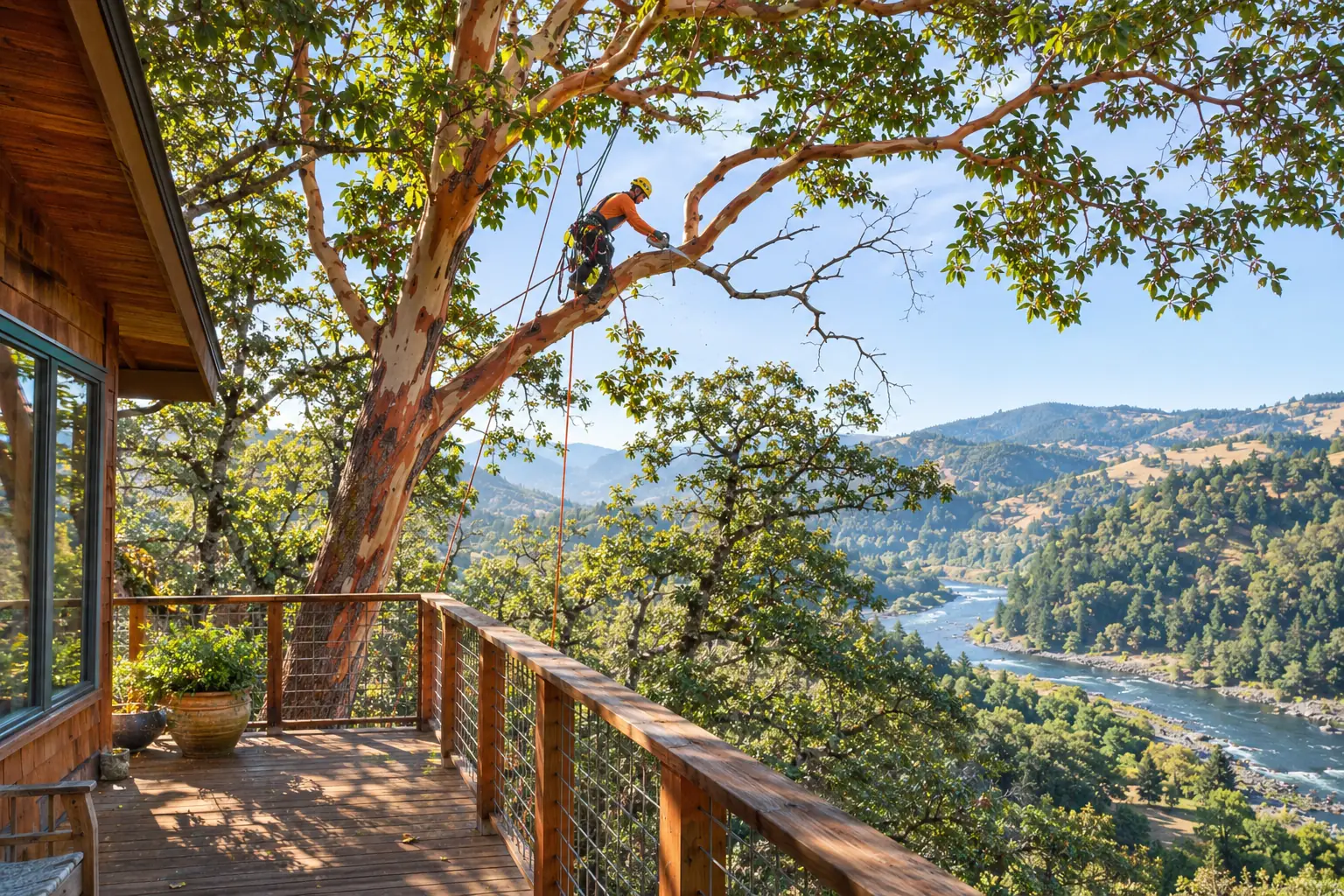
| Tree crew with climbers or a lift | Takes out chosen large trees in sections | Big trees near structures or keepers |
Mulching leaves the ground covered, which helps against erosion on slopes. Pulling stumps and grubbing roots leaves bare soil, which is needed for a foundation but has to be protected before rain. The hillside tree work guide explains access and erosion on steep ground in more detail.
Protect the roots of the trees you keep
Many clearing jobs save the right trees and then hurt them with machines. The ISA's tree hazards page lists severed roots, soil compaction in the root zone and roots smothered by fill soil as causes of decline. It says poor drainage must be corrected or trees will decline rapidly.
Ask the company to fence off or flag a root protection zone around each keeper, keep tracked machines and log piles out of it, and avoid grading or piling soil there. A grade change under a big oak can kill it slowly over several years.
Rules that usually apply to clearing
Clearing land touches more rules than cutting a single tree. Ask the city or county about your parcel before work starts, since rules change and each lot is different.
Erosion control in the city. Gold Hill's Title 17, Section 17.50.020, requires an erosion prevention and sediment control plan before certain building and grading permits are approved. The triggers include disturbing 2,500 square feet or more of land, disturbing land or native vegetation within 50 feet of the top of a stream or river bank, or disturbing 500 square feet or more on slopes of ten percent or steeper. Section 17.50.050 adds that during the rainy season, November through April, soils under such a plan are not to be left exposed for more than seven days in a row.
The Rogue River band. Section 17.49.040 keeps vegetation and tree cover within 75 feet of the top of the Rogue River bank, with limited exceptions such as replacing non-native plants with native trees and shrubs under a landscape plan. Call Gold Hill City Hall at (541) 855-1525.
County land. Outside the city, Jackson County rules apply. The Jackson Soil and Water Conservation District's riparian guide says the county keeps trees and shrubs within 75 feet of the Rogue and 50 feet of other streams, measured from the top of the bank, and that clearing them for wildfire fuelbreaks is not allowed. Jackson County Development Services lists Planning at 541-774-6907 and Building at 541-774-6927.
Selling timber. If logs from the clearing will be sold, ask the Oregon Department of Forestry whether a notification of operation is needed first.
Buried lines. Any digging, stump pulling or grading needs a utility locate. Call 811 at least two full business days ahead, per Dig Safely Oregon.
Fire season and the clearing calendar
A clearing job is heavy saw and engine work, so fire season has a big effect on how long it takes. ODF's Southwest Oregon Regulated Closure Proclamation No. 01, effective May 15, 2026, bans power saws and other spark-emitting engines at extreme fire danger. At moderate danger they run only before 1 p.m. and after 8 p.m., and at high danger only before 10 a.m. and after 8 p.m. Engines also need a cleared area free of flammable vegetation for 50 feet and a hose or extinguisher on hand. Debris burning is banned all fire season.
Large jobs on forestland may also fall under ODF's Industrial Fire Precaution Levels, which are written for logging and other operations. They run from Level I, where a fire watch is required, through Level II and Level III limits on saws, yarding and loading, to Level IV, a complete shutdown. Ask the company and ODF's Southwest Oregon District office (541-664-3328) which set of rules covers your job.
Pine slash has its own timing. ODF's slash fact sheet says slash made from October through December can dry before beetles fly, and that pine slash cut from January through September should be chipped or otherwise destroyed quickly. Late fall, after fire season ends, is usually the smoothest time to clear. The fire season rules guide has more.
What lot clearing costs
Clearing is priced by the acre or by the project, and density matters most. Lawn Love's land clearing cost guide, updated December 27, 2025, gives these national figures:
| Type of clearing | National range (Lawn Love, Dec. 2025) |
|---|---|
| Typical project, half an acre to 2 acres | $1,565 to $4,520, average $2,900 |
| Lightly wooded lot | $580 to $2,100 per acre |
| Heavily wooded lot | $3,300 to $5,600 per acre |
| Mostly brush | $330 to $630 per acre |
Steep slopes, rock, keeping many trees, stump pulling, hauling instead of chipping, and fire season delays all push a Gold Hill job toward the top. The written estimate from the company you are connected with is the real number. The tree service cost guide and the brush removal page cover smaller jobs.
Questions for the clearing company
- Which trees are you keeping, and how will you protect their roots?
- Will you mulch, chip, haul or pile the material?
- Are stumps ground, pulled or left?
- How will bare soil be covered before the rain?
- Does any part of the lot fall within 75 feet of the Rogue or 50 feet of a creek?
- Who files the 811 locate?
- What is your CCB number? Check it on the Oregon CCB license search.
Frequently asked questions
Do I need a permit to clear my lot near Gold Hill?
It depends on the parcel and the project. Inside the city, building and grading permits can trigger an erosion control plan, and the river band has its own rule. Outside the city, ask Jackson County Planning at 541-774-6907.
How long does it take to clear an acre?
It varies with density, slope and method. A mulcher on open, brushy ground covers far more in a day than a hand crew on a steep, rocky slope. Fire season saw hours can stretch any job.
Should I keep the oaks when I clear?
In most cases, healthy mature oaks are worth keeping. ODF notes white oaks are very wind firm, and OSU suggests favoring oaks and pines on dry sites. Remove the firs and brush crowding them instead.
Can I burn the brush from clearing?
Not during fire season, when ODF and Jackson County ban debris burning. Outside fire season, check the county's daily burn advisory at 541-776-7007 and get a permit from your fire agency.
How can I keep the cost of clearing down?
Leaving mulch on site, keeping healthy trees, scheduling outside fire season and getting stumps ground on the same visit all keep the cost down. Ask the company which of these fit your land.