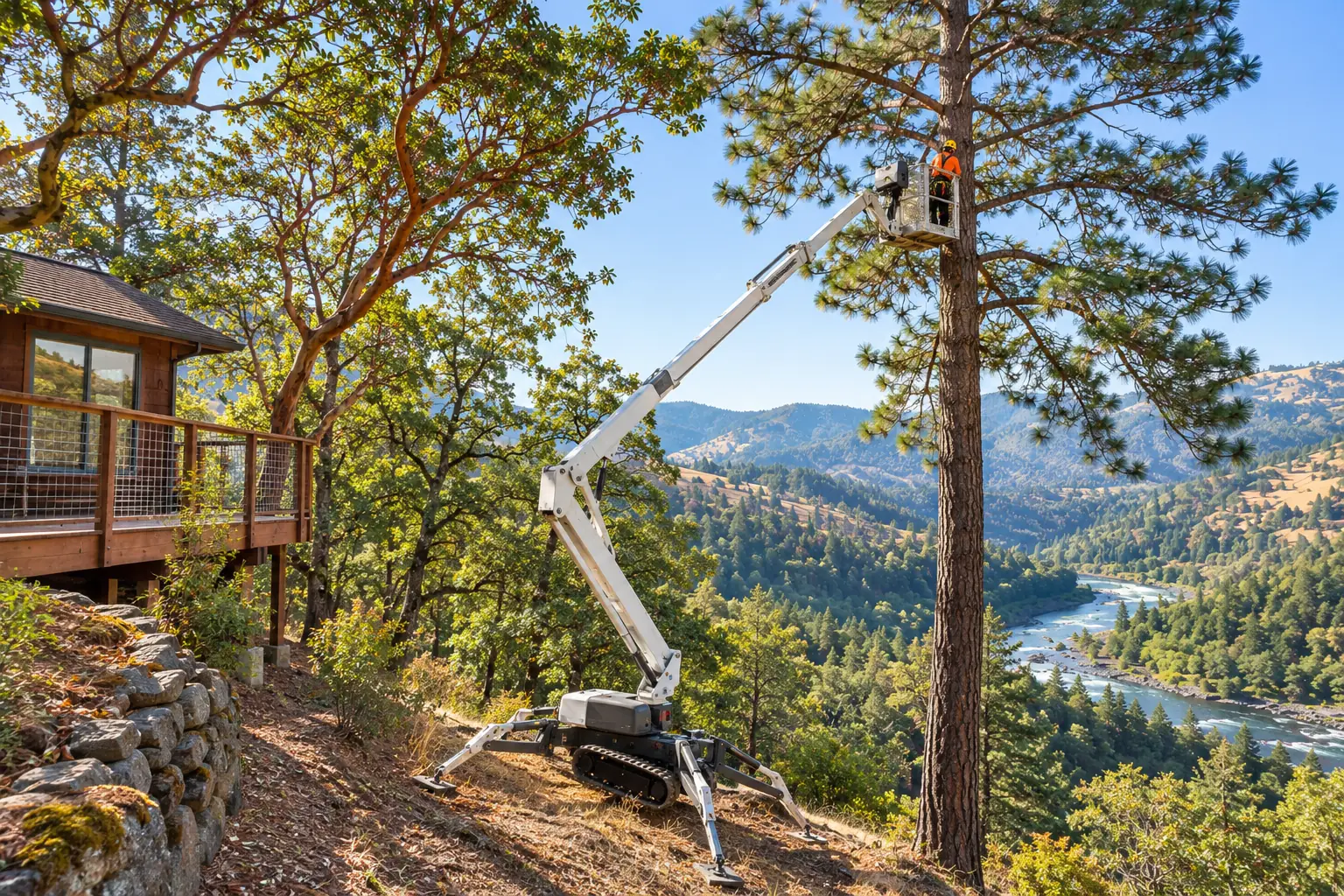
Tree service in Jacksonville usually begins on the phone: (541) 502-8114 puts you through to an independent tree company that holds an Oregon CCB license, and to no other. Find out on that call if your street, in town or up in the wooded hills, is one it works. Before you book pruning or a removal, check one thing: Jacksonville's code covers many large live trees, including topping, so the company's estimate and the city's answer should come together.
A town that counts its canopy
Jacksonville treats its trees as part of its landmark status. The city's Development Code says about 64 percent of the land inside city limits is under tree canopy, against a national average of about 30 percent, and credits the forest tracts and the town's historic, rural character. The code also points to a Community Forestry Plan with a historically appropriate street tree list, meant for public and private work alike.
The town is small. The 2020 Census counted 3,020 residents. City Hall is at 206 N 5th Street, and the Planning Department's direct number is 541-899-6873.
Does your tree job need a city permit?
Work through these four questions before anyone climbs. All four come from the code's tree removal section, 18.18.020, as amended in December 2023.
- Is the tree alive and at least 12 inches across? The section covers live "resource trees" with a trunk 12 inches or wider, measured at a height of 4 feet. A dead tree falls outside that wording, but call Planning to confirm before it comes down.
- Is the job topping? Topping one of these trees is treated like removing it. For heavy pruning that stops short of topping, ask Planning whether it counts.
- What zone is the lot in? Lots zoned Historic Core, General Commercial or Artisan, plus land covered by the riparian and wetland rules, need a tree removal permit from the Planning Department. The application includes a site plan to scale, the reason for removal, what will be replanted, an arborist's report when the city wants one, and the fee. Most other residential lots can get a permit through a simpler review by the Planning Director. On land zoned Hillside Residential or Special Protection, the standards in Section 18.20.080 replace this section.
- Which reason fits? The code allows removal of a tree that is in danger of collapse, needed to protect a historic building, home or commercial building, ruled a fire hazard by the Fire Chief, diseased enough to threaten its survival, or standing where a planned building, street, driveway or parking area must go with no other design possible.
Fees, nuisance trees and replanting
Some removals cost nothing in city fees. Planning issues a no-fee permit when a tree could collapse at any moment and plainly threatens people or property, though the city can still require an arborist's review that you pay for. Nuisance species also skip the fee. The code names tree of heaven, the cottonwoods, poplars and aspens of the genus Populus, and Leyland cypress, except where the riparian rules protect them.
After a removal, the code asks for a new tree to go in for every one taken out. It should be healthy, fire-resistive and no thinner than 1.5 inches in caliper at 4 feet, and it should suit the spot where it is planted. The Planning Director may waive replanting, and fire safety rules that call for removal take priority over the section. Ask the company to include a replacement tree on the estimate if you want one line item for the whole job.
Building near big trees
If tree work is part of a building or grading project, a separate set of standards applies. Section 18.18.030 asks that trees marked for keeping be fenced at the drip line before any clearing, grading, trenching or paving, and that parking and material storage stay out of those fenced areas. That matters on lots with large old trees, which Jacksonville has plenty of. The best known is a giant sequoia that Peter Britt planted in 1862, the day his son Emil was born. Historic Jacksonville calls it an official Oregon Heritage Tree, more than 200 feet tall, near the Britt Gardens.
The trees on Jacksonville's hills
Away from the historic core, much of the wooded land around town is madrone, oak and conifer. The Southern Oregon Land Conservancy describes the Jacksonville Woodlands as dominated by Pacific madrone, California black oak, ponderosa pine and Douglas-fir, with some old-growth whiteleaf manzanita.
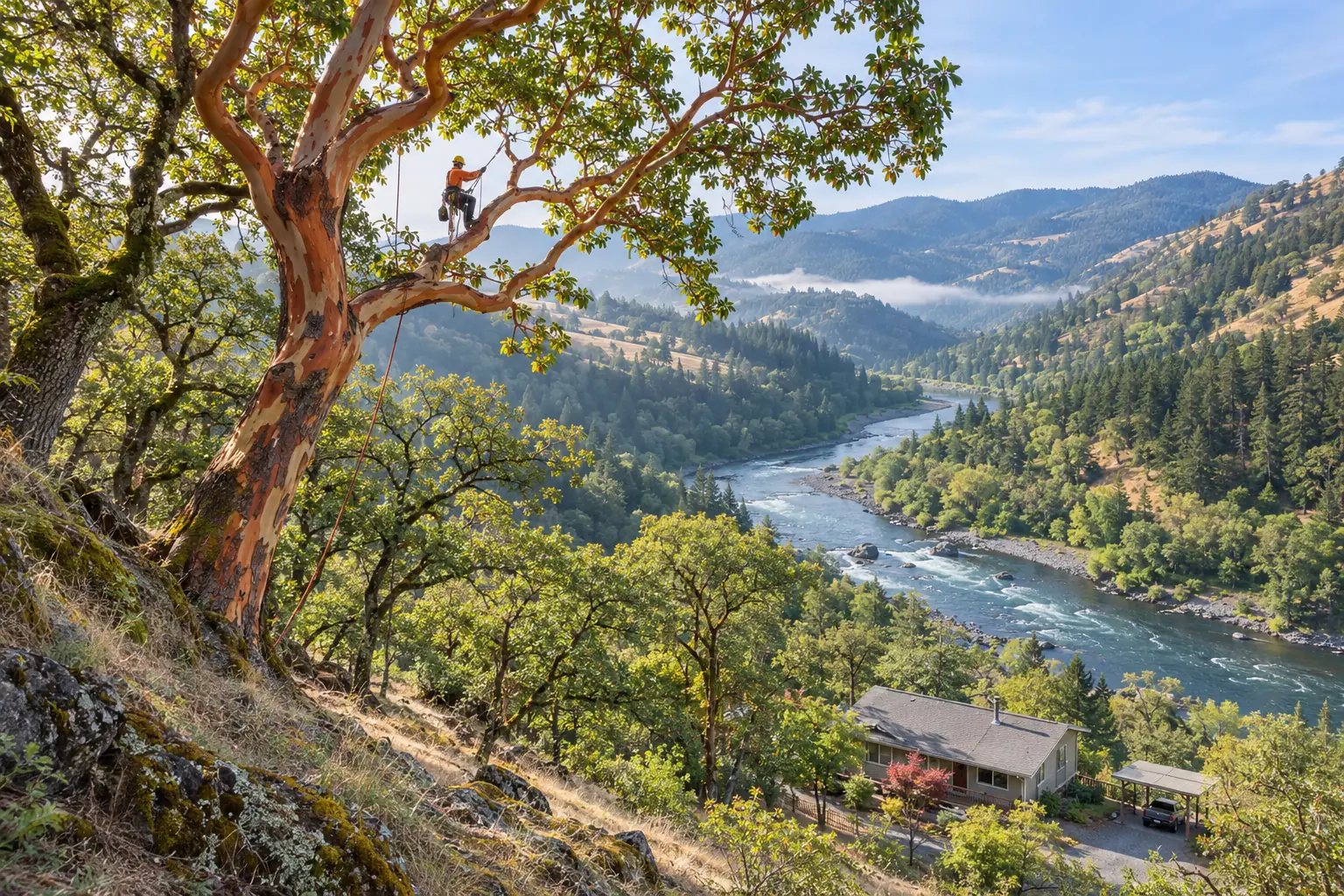
Each of those trees asks for different care. Madrone has thin bark that scars easily, an old black oak may hold deadwood over a roof, and big pines and firs on slopes may need rigging rather than a clean drop. Read the guide to madrone and oak care, the page on pruning and trimming, and the guide to hillside tree work for steep lots.
Long driveways in the wildfire overlay
Homes on the city's Urban/Wildland Interface map fall under Chapter 17.40 of the code, and some of its standards decide how a tree truck reaches you. Driveways longer than 200 feet are to have turnouts 20 feet wide and 40 feet long, spaced no more than 400 feet apart. Bridges and culverts are to carry 50,000 pounds. Driveways need 13 feet 6 inches of clear height, and vegetation stays at least 10 feet from a chimney.
Low limbs over a long drive are a common reason to call a tree service, and that clearance standard gives a clear target. Mention the length of your driveway and any bridge when you call.
Who to call
| Question | Who answers it |
|---|---|
| Does my tree need a permit? Which zone am I in? | Jacksonville Planning Department, 541-899-6873 |
| General city questions | Jacksonville City Hall, 541-899-1231 |
| A branch growing near a power line | Pacific Power, 1-888-221-7070 |
| A limb or tree lying on a power line | 911 first, and Pacific Power after, 1-877-508-5088 |
| A price for pruning, removal or stump grinding | (541) 502-8114 |
Calling (541) 502-8114 is free. You are connected with an independent tree company licensed by the Oregon CCB, a single company. Request a visit and an estimate on paper from it, and bring up the permit question during that visit. Get its CCB number and look it up on the CCB license search. For removals, see the tree removal page, and for leftover stumps, stump grinding.
Out Highway 238, see tree service in Ruch. To the northeast, see tree service in Central Point. The home page lists the full service area.
Frequently asked questions
Does topping a tree in Jacksonville need a permit?
It can. The code treats topping a live resource tree, one 12 inches or wider at 4 feet up, the same way it treats removal. Call the Planning Department at 541-899-6873 before any topping or heavy crown cut.
Does a hazard tree in Jacksonville cost a permit fee?
Not when the tree could fall at any moment and clearly threatens people or property. Planning issues that permit for free, but it can require an arborist's report, and you would pay for that.
Which trees can be removed in Jacksonville without a fee?
The code's nuisance species, among them tree of heaven, Leyland cypress and the Populus group of cottonwoods, poplars and aspens, get a free permit unless the riparian rules protect them. You still need the permit, so call Planning first.
Is replanting required after a Jacksonville tree comes down?
In most cases. Expect to plant one fire-resistive tree, 1.5 inches or more in caliper, for every tree taken out. The Planning Director can waive that, and fire rules that require removal come first.